

Introduction
GamePanel runs game servers in Docker and gives you a web interface to manage them: start and stop them, watch the console, edit files, take backups and share access with other people.
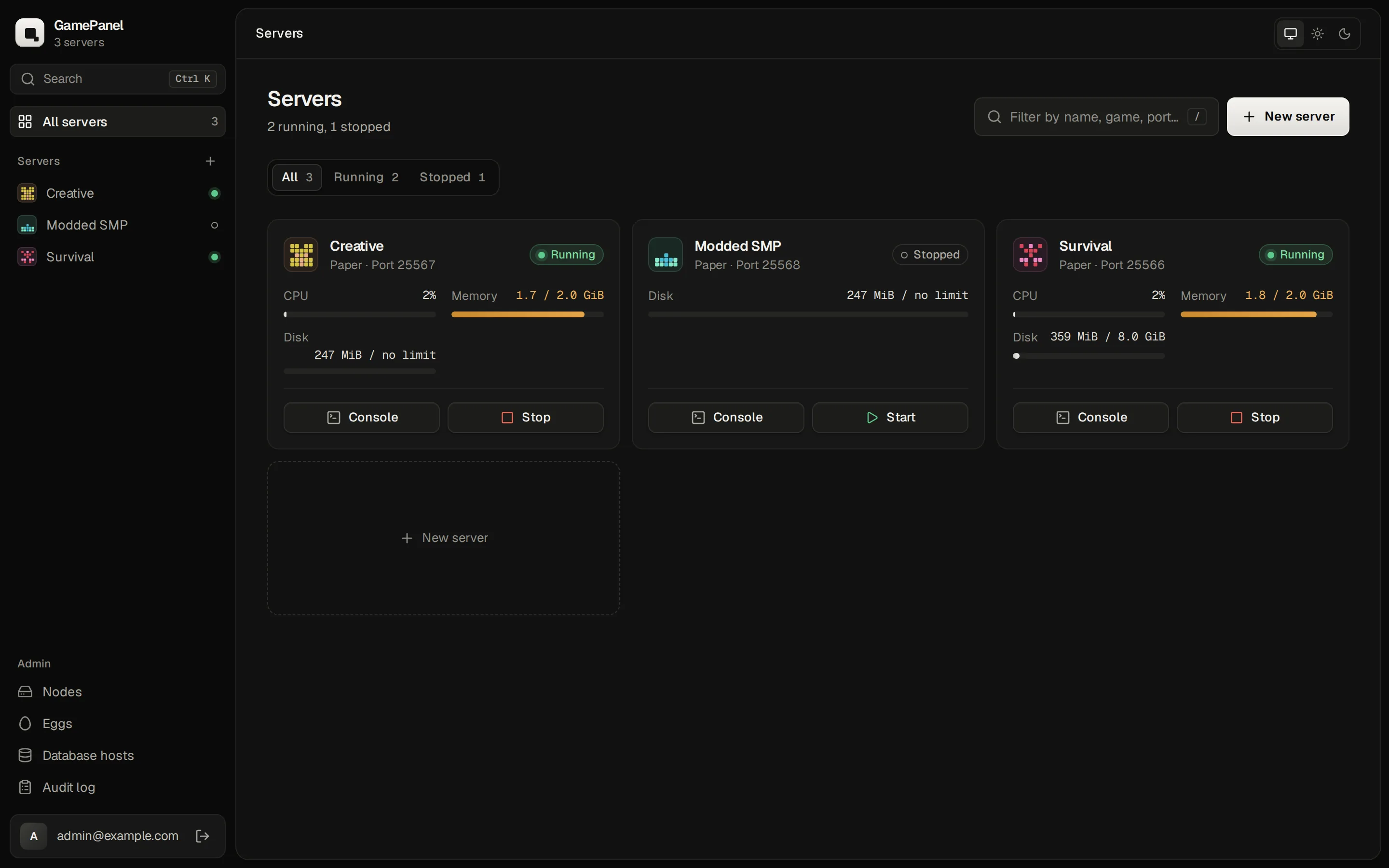
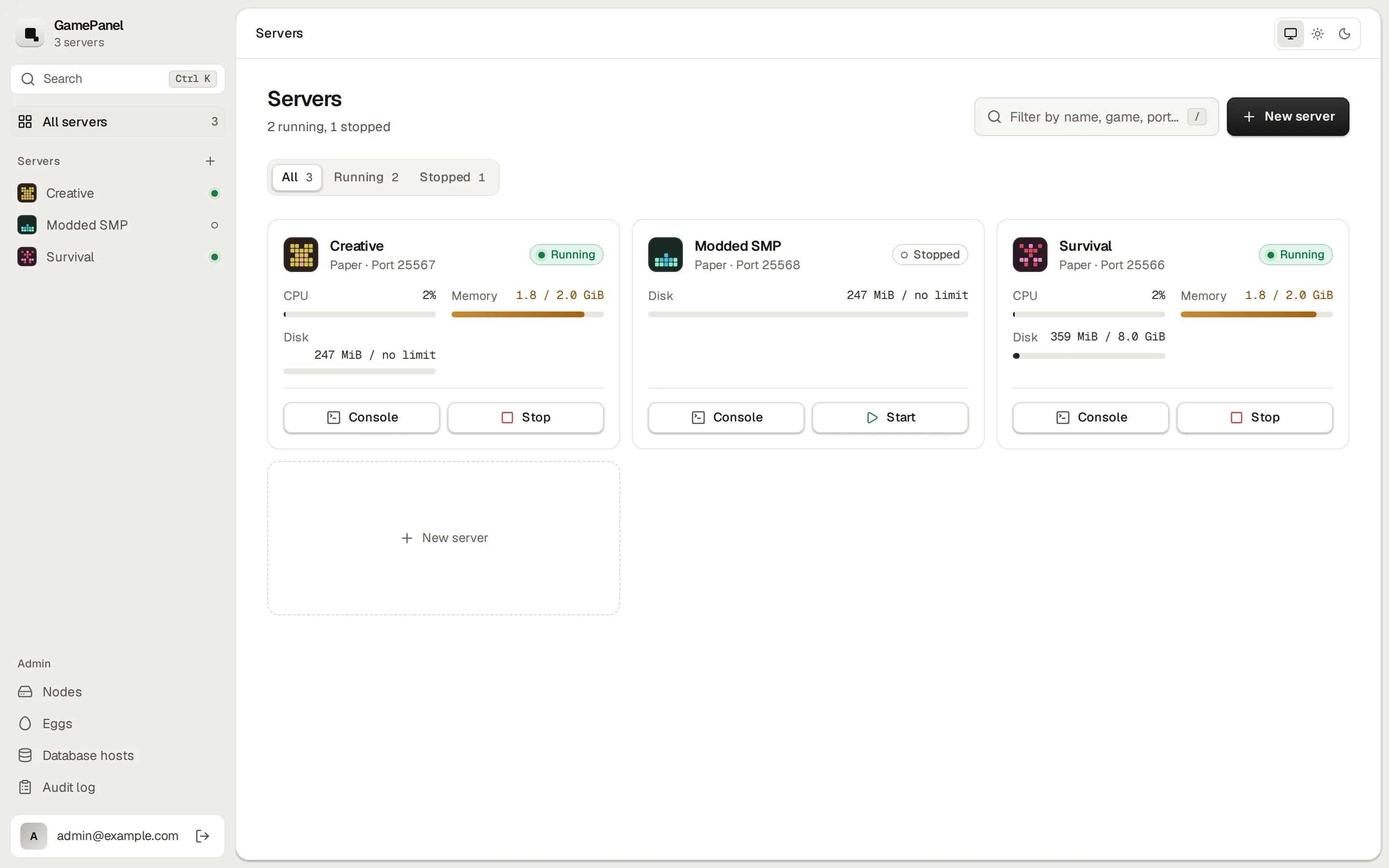
It has two parts:
- The panel is one Go program. It serves the web interface and the API and keeps everything in one SQLite file. You run one panel.
- The daemon runs on every machine that hosts game servers (a node). It drives Docker and connects out to the panel. You run one daemon per node. The panel's machine can be a node too.
It is a simpler, stricter alternative to Pterodactyl and Pelican. It reads their egg files (the recipes that say how to install and start a game) as they are, so the games you already run keep working. GamePanel compared sets it beside Pterodactyl, Pelican, PufferPanel, Crafty and AMP, including where it is still behind.
Who it is for
- People running servers for themselves and friends: one machine, one panel, a few servers.
- Communities and clans that share servers between several admins, each with their own permissions.
- Small hosting businesses that sell servers: the shop API creates, suspends and removes servers when a billing system tells it to, and webhooks tell the billing system when an install finishes.
What it does
| Area | What you get |
|---|---|
| Servers | Power controls, live console, CPU, memory and disk charts with 30 days of history, per-server limits |
| Files | A file manager with an editor, search, drag-and-drop upload, archives, pull from URL, and SFTP |
| Mods | Search and install from Modrinth, checked against Modrinth's hashes |
| Startup | Egg variables (checked against the egg's rules), Docker image choice, custom startup for admins |
| Network | Several ports per server, with notes, and a bandwidth limit |
| Databases | MySQL/MariaDB databases per server, each with its own user |
| Backups | On the node or in any S3-compatible store; lock, restore, download |
| Schedules | Cron-style tasks: commands, power actions, backups |
| Access | Subusers with per-server permissions, invitations by email |
| Accounts | Passkeys, two-factor, single sign-on, API keys, session limits |
| Admin | Nodes with capacity tracking, eggs, database hosts, audit log |
| API | Everything the interface does, documented with OpenAPI 3.1, plus a Pterodactyl-compatible client API |
How these docs are organised
- Getting started explains how the parts fit and what you need.
- Panel and Nodes are for whoever installs and runs it.
- Administration is for panel admins: nodes, eggs, accounts, servers.
- Using servers is for everyone who has a server, owner or subuser.
- API and integrations is for scripts, bots and billing systems.
- Reference covers troubleshooting, the security model and every limit.
Status
GamePanel is pre-alpha. It works end to end and has an extensive test suite (Go tests with the race detector, component tests, and a Playwright suite in a real browser), and the Docker runtime is checked against a real engine. It has not run in production. See the production checklist for what that means in practice.
Not built yet: Pterodactyl's application (admin) API and websocket, PostgreSQL, Windows game servers, billing, CurseForge.
Not verified: Windows and macOS Docker hosts, Podman, and unusual bind mounts.